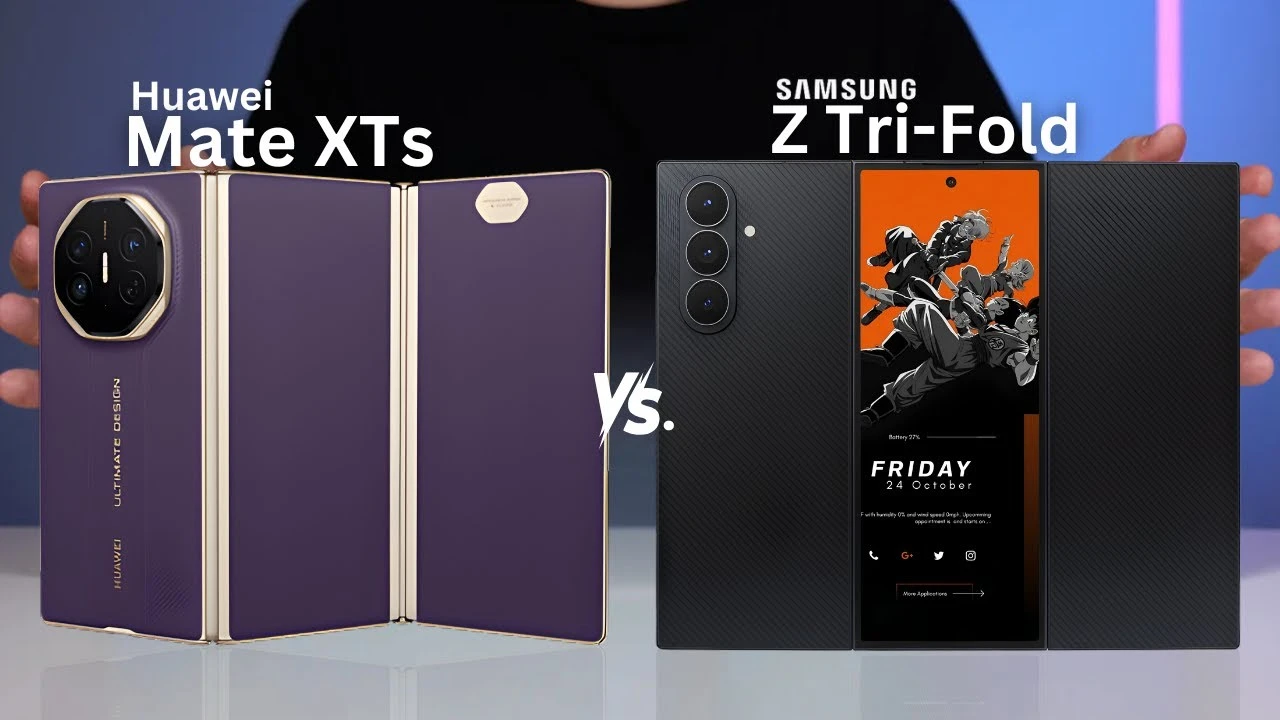
Triple-fold smartphones are finally becoming real products, not just tech demos. Samsung has stepped into this new category with the Galaxy Z TriFold, and its closest rival at the moment is Huawei’s Mate XTs, which arrived earlier this year. Both devices attempt to merge a phone and tablet into a single foldable form, but they take noticeably different routes to get there. Here’s a clear, easy-to-understand comparison of the two.
Design
Samsung’s approach focuses on protecting its internal screen. The Galaxy Z TriFold folds inward using two hinges, and when everything is closed, the phone works like a regular device with a 6.5-inch cover display on the outside. Once fully opened, the large inner panel spreads out into a tablet-like layout. Samsung also added software checks that alert you if the device isn’t folded properly. The unfolded body is impressively thin at 3.9mm, though the weight climbs to 309g.
Huawei takes a very different route. The Mate XTs folds outward, leaving the 10.2-inch OLED panel exposed at all times. This design gives users the full screen no matter how they hold the device, but it also makes the display more vulnerable to scratches because nothing covers it when folded.
Display and Performance
Samsung equips the TriFold with a 10-inch AMOLED panel offering QXGA+ resolution, a 120Hz refresh rate, and brightness up to 1,600 nits. Powering this setup is a customized Snapdragon 8 Elite chip paired with 16GB RAM and either 512GB or 1TB storage.
Huawei’s Mate XTs uses a slightly larger 10.2-inch OLED display with a detailed 2232×3184 resolution. Inside, it runs on the Kirin 9020 processor. Both aim to deliver smooth multitasking, but Samsung’s chipset is currently the more powerful of the two.
Camera
Samsung’s triple-camera system centers on a 200MP primary sensor. It’s joined by a 12MP ultrawide lens and a 10MP telephoto offering 3x optical zoom. Samsung includes 10MP front cameras on both the cover and main displays.
Huawei goes for a different sensor arrangement: a 50MP main camera, a 40MP ultrawide, and a 12MP telephoto. The front camera is 8MP. While Samsung prioritizes resolution and detail, Huawei emphasizes a balanced setup.
Battery and Charging
Samsung distributes its 5,600mAh battery across all three folding sections, helping weight and power stay balanced. Charging speeds include 45W wired and 15W wireless options. The device also carries an IP48 rating, meaning it can handle water exposure up to 1.5 meters for 30 minutes.
Huawei matches Samsung in capacity with another 5,600mAh battery, but offers faster speeds: 66W wired and 50W wireless charging. Huawei does not highlight the same level of water resistance, which may matter to some users.
Also Read: POCO X6 Pro 5G Performance Boost Makes It a Strong iPhone Alternative
Software
Samsung ships the Galaxy Z TriFold with Android 16 layered with One UI, tuned to take advantage of the tablet-like layout and multi-window features.
Huawei uses HarmonyOS 5.1, which also supports multitasking, but operates within Huawei’s own ecosystem rather than Google’s.
Final Thoughts
Samsung and Huawei have taken two very different paths to build a triple-fold phone. Samsung focuses on protecting the main display, boosting processing power, and offering a balanced tablet-style experience. Huawei leans toward a bold outward-folding design with faster charging and a larger exposed screen.
If you want durability, strong performance, and a protected internal display, the Galaxy Z TriFold feels more refined. If you prefer a single expansive screen that’s always visible and don’t mind the trade-offs, the Mate XTs offers a unique alternative.